Creativity - the human-made premium is real

Updated: Jun 19
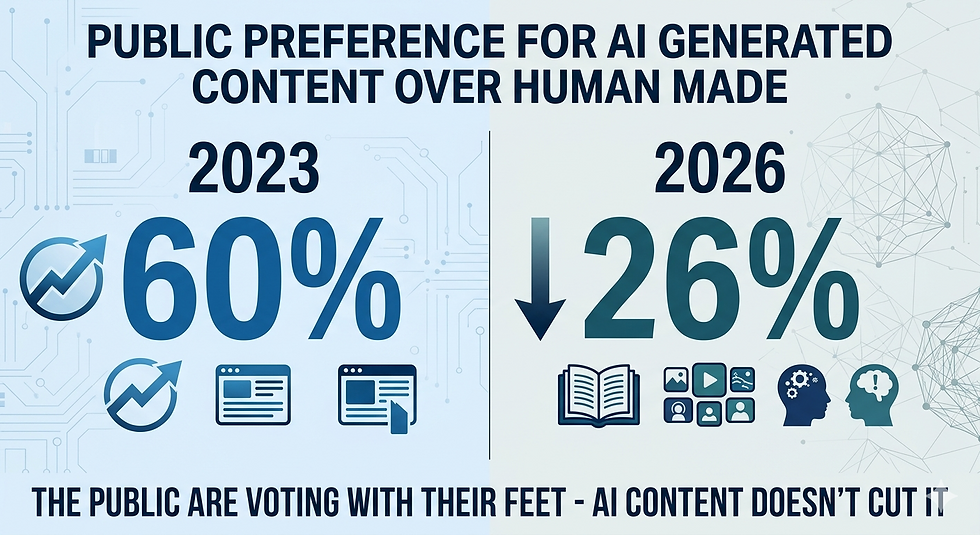
In 2023, around 60% of consumers said they preferred AI-generated content to the human-made alternative. By the start of 2026 that figure had collapsed to 26%. This signals a market that's changing very fast - and it’s handing a huge commercial advantage to anyone still making things the hard way.
For several years I’ve had two words sitting on my profile: human made. I wrote them when the smart money was pouring into automation and the consensus was that anyone defending human craft was a sentimental fool clinging to a dying trade.
I got the odd raised eyebrow for what I said. But it turns out the eyebrows were premature.
There’s now a name for the thing I was banging on about. They’re calling it the human-made premium, and unlike most marketing buzzwords, this one has facts behind it.
What the premium really is
The human-made premium is the extra value people place on something because they know a human made it. Not a machine. A person, with taste, judgment and the odd bad day.
For most of the last three years that idea would have sounded quaint. Content got cheaper, faster and more plentiful, and cheaper-faster-more usually wins. But something shifted when the supply became infinite. When everyone can generate a passable blog post, a passable image and a passable video before their coffee has even cooled, 'passable' is not worth anything.
(A word of warning here, because your audience is sharper than it used to be. A vague claim that your content is ‘reviewed by humans’ no longer does the job. People have worked out what that phrase means. The premium attaches to genuine craft, not a reassuring line in your small print).
The proof this is a market correction, not a mood
I’m wary of trend pieces built on vibes, so let’s look at what the data says.
Consumer trust in AI-generated content is now sitting at about a third, with one 2026 report finding only 35% of people trust it at all. Worse, for anyone relying on it, a study of 2,000 UK and US consumers by Bynder found that 52% say they become less engaged the moment they suspect a machine wrote what they are reading.
Then there's the wider mood. Roughly 54% of Americans now say they are tired of hearing about AI altogether. And when Pew asked the public how they feel about AI creeping into daily life, half said they were more concerned than excited, against just 10% feeling the other way. People aren't dazzled by AI any more. They’re wary, and many are simply worn out.
The logic of all this is simple enough. When a thing becomes over-abundant, scarcity moves elsewhere. The market flooded itself with good enough, and the audience responded by placing a premium on the one thing that suddenly felt rare: the genuine article, made by an actual human being.
Three decades worth of receipts
This is where I get to be smug, briefly, so indulge me.
I’ve spent more than thirty years selling the human-made premium without knowing that it had a name. In the 1990s I ran a creative agency in Amsterdam handling drinks and tobacco brands, two categories where you cannot simply state the benefit and walk away. You have to build a world, a feeling, a reason to care, because the product won't do that. None of that came from a template. It came from people who understood the culture they were selling into.
Later, working with Hollywood studios and US broadcast networks, the job was basically the same. Persuade an audience to feel something about a story before they saw a frame of it. You can‘t automate that. The craft is the product.
Please note that I’m not telling you this to dust off old war stories, I’m telling you because the work that survived, the work that moved people and shifted product, was always the work that carried a human fingerprint. That was true when the competition was other humans. It's even more true now when the competition is a machine producing sameness at scale.
Before you brand me a Luddite
Let me head off the obvious objection. This is not another anti-AI rant. I use the tools. They're genuinely good at things humans are bad at or bored by: producing variations at volume, iterating creative for performance media, running tests at a scale no team can manage by hand. In those settings AI can match a human and frequently beat one on cost. It would be false to pretend otherwise.
However, what AI cannot do is decide what something means. It cannot carry emotional trust in the moments that actually matter to a brand, the launch, the apology, the big seasonal set-piece where getting it wrong is expensive and very public. The brands coming unstuck right now are not the ones using AI. They’re the ones who handed it the jobs it was never built to do. Ask McDonald's about the AI Christmas ad they pulled. Ask Coca-Cola, who keep poking the same bruise.
The winners in 2026 won't be the brands using the most AI, or the least. They’ll be the ones who know precisely where the line sits and have the discipline not to cross it for the sake of saving money.
So what do you actually do about it?
If you run a marketing or comms team, the practical version of all this is clear. Protect the human craft in your high-trust, high-emotion touchpoints. Brand identity, the work that carries your voice, the campaigns tied to moments that matter to people. That's not where you go looking for efficiency savings.
Be honest about where you do use AI. Audiences now expect disclosure, and the cost of getting caught hiding it is steeper than the cost of admitting it. Roughly nine in ten consumers say they want brands to come clean about AI use.
And stop treating authenticity as a value to hang on the office wall. It’s not a poster. It’s a strategy, with a measurable return, and the businesses treating it that way are pulling ahead of the ones that aren't.
Final word
The slop was always going to flood in. The only real question was how long before people got sick of it.
Well, here we are. Sixty per cent down to twenty-six in just three years. The audience has voted, and it turns out they can tell the difference between something a person made and something a machine assembled.
And that creates two options. Now that human craft has a price tag on it again, are you going to pay for it, or are you going to keep serving up the slop and hope that no-one cares?
Follow Chris Godfrey for regular insights and opinion on the business of content & marketing. Subscribe to CONTENTED now


Get started with Freelance Words
Strong communication is the bedrock of good business and when there’s a lack of it, problems can arise. Take the ambiguity and doubt out of what your business needs to say. Contact us now.


Comments