The revenue leak your analytics will never show you

Updated: Jun 19

B2B organisations are losing clients to competitors' thought leadership without ever knowing it has happened. A 2024 Edelman report found that 86% of decision-makers are more likely to invite a company into an RFP based on its content alone, yet only 38% of content producers expect that return. Most are measuring the wrong metrics. The commercial risk sits far upstream of anything their analytics can track.
Somewhere this week, a decision-maker who has been a client of yours for several years will read a piece of content from one of your competitors. It will be specific, authoritative, and it will make them think differently about a problem they assumed you were solving. They won’t call anyone. They won’t fill in a form. But something will shift and they’ll quietly go away.
You won’t even know it’s happening until it’s far too late.
This is where thought leadership lives. Not in traffic reports. Not in LinkedIn impressions. But in the quiet recalibration of someone's opinion about who is worth their attention and their money and who is not.
According to Edelman, a quarter of UK senior decision-makers have ended or significantly scaled back a supplier relationship specifically because of thought leadership produced by a competitor. Not because the incumbent’s product was inferior. Not because their service failed. But because someone else's content redefined the problem and planted a flag on territory the incumbent never thought to claim.
That number should worry you, because it won’t appear in any dashboard you look at this week.
The opportunity most B2B organisations are missing
The same Edelman research found that 86% of decision-makers say they are more likely to invite a company into an RFP process based on its thought leadership content alone.
However, only 38% of content producers expect that type of outcome.
The gap is not a measurement discrepancy, it’s a systemic underinvestment in one of the most commercially potent tools in any B2B organisation's kit.
Most companies fund their thought leadership as though it were a brand awareness exercise, then wonder why they cannot point to a return. But the fact is, they’re measuring the wrong things. Reach, shares, and comments are visible. The assumptions a buyer is forming about your expertise six months before they have a budget are not. By the time thought leadership shows up in a revenue number, the real work happened long ago, in content your sales team never saw and your analytics never tracked.
60% of B2B decision-makers say they’re more willing to pay a premium to work with an organisation that produces strong thought leadership. That’s a pricing conversation being conducted entirely through content, without a salesperson in the room.
Why the conditions have never been better for getting this right
There’s another complication that needs understanding: the B2B content landscape is not the same as three years ago. According to analysis by SEO firm Graphite, AI-generated material now accounts for more than half of all English-language content on the web. On LinkedIn, there’s been a 189% increase in AI-generated posts since ChatGPT launched in 2022, with more than half of long-form content now suspected to be machine-written.
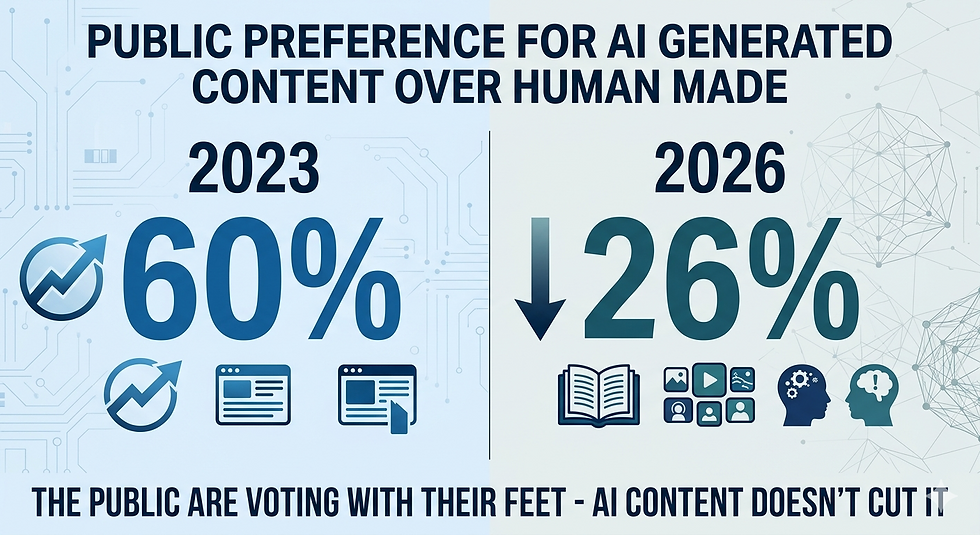
Your buyers are swimming in it, and they know what it looks like. Research by content platform Bynder found that 52% of consumers disengage entirely when they suspect content is AI-generated, regardless of its actual quality. Preference for AI content has fallen from 60% in 2023 to just 26% today.
As the volume of machine-generated work increases, the scarcity value of genuine human thinking goes up. This is not a minor shift in audience taste. It’s a structural change in how credibility gets allocated, and right now the organisations that understand this are sitting on a significant competitive advantage.
The market for credible, experience-led thought leadership has never been more open. It's also more thinly competed than it looks, because so many organisations have decided that volume is easier than quality.
What this means to you
The commercial case for thought leadership is far stronger than most B2B marketing teams understand. The evidence is there. The numbers are real. But the argument rarely gets made in language that connects content to revenue, because too many programmes are being evaluated as a marketing cost rather than a commercial asset.
The organisations that will own their category over the next five years are not necessarily the ones spending big on content. They’re the ones investing in content that earns its authority, takes a genuine position, and treats their buyers as intelligent people capable of spotting the difference between real thinking and assembled noise.
Final word
Our new report, The No-Nonsense Guide to Thought Leadership, sets out the full case: the criteria that separate credible content from the forgettable, the commercial return that's being systematically left on the table, and, most importantly, what a serious thought leadership programme needs to function. Click the image to read or download the guide. No email required.

Follow Chris Godfrey for regular insights and opinion on the business of content & marketing. Subscribe to CONTENTED now


Get started with Freelance Words
Strong communication is the bedrock of good business and when there’s a lack of it, problems can arise. Take the ambiguity and doubt out of what your business needs to say. Contact us now.


Comments