The peak content effect. Is anyone listening to what you say?

Updated: Aug 7

Content saturation has reached a tipping point. The average person is exposed to over 5,000 pieces of content daily yet consciously registers fewer than 100. With social media engagement falling and AI flooding every channel, most business content is effectively invisible. This article examines why we've hit peak content, what it means commercially, and what it takes to produce work that actually cuts through.
Imagine a small town in medieval times. The weekly market is in full swing. Folks are quietly going about their business.
Suddenly, a merchant stands on a box and makes a loud announcement about his wares. Everybody stops to listen. They like what he says. They flock to his stall. Sales skyrocket.
Other merchants take notice.
Next week, there are two sellers calling out. The people are thrilled by their competing narratives. Sales continue to rise.
A week later, there are eight tradesmen shouting about their products and the crowd feels a little overwhelmed. So much noise. So much choice. Audience attention becomes fragmented. Sales begin to plateau.
Three months later, ALL the sellers are screaming at the top of their lungs. It’s a deafening cacophony. Nobody listens. Nobody comes to the market. Commerce takes a nose dive and the town falls into recession.
Now transfer this simple narrative to today.
Every business smashing out messages at a rate of speed. Billions of them, 24/7, with AI making the volume ever faster, ever greater, ever cheaper. It’s a wall of information you can’t escape from without moving to a desert island. Yet the limiter - our concentration - remains the same. When we’re exposed to thousands of ads, our psychological bandwidth tunes out almost all of them to prevent cognitive overload.
And this is where we are.
Let’s call it the peak content effect. Or, to paraphrase a well-worn saying: if a piece of content is published in the forest and nobody’s there to read it, did it even happen?
What do businesses do when nobody, literally nobody, hears what they say?
The numbers don’t lie
In the 1970s, the average American encountered around 500 brand messages a day. Today, that figure sits somewhere between 4,000 and 10,000. The volume has increased twenty fold.
Of those thousands of daily exposures, we consciously register fewer than 100. It’s a survival technique. When the sensory system is overwhelmed, it stops processing. If you think I’m wrong, consider this; over 900 million people across the globe use ad blockers on their devices, actively building walls between themselves and marketing they never asked for.
Folks have had enough.
Typical screen-based focus has dropped to only 43 seconds, as we’re exposed to an average of over 5,000 pieces of content daily, up from 1,400 in 2012. The content supply has roughly quadrupled in a little over a decade. Genuine human attention hasn’t budged an inch.
It’s not just AI. But AI isn’t helping.
You might assume this is mostly an AI problem. It's not, although it's certainly made it worse.
The saturation trend has been building for years. A 2026 analysis of nearly 40 million social media posts found that average views per post fell 17% year-on-year while interactions dropped 32%. Yet, in the same period, posting frequency jumped by 22%. More content + less engagement = bad idea. The businesses that responded to declining returns by simply publishing more are learning that volume won’t reverse the trend.
AI generated content has only accelerated the problem. It now accounts for more than half of all the English-language material on the web. On LinkedIn, there’s been a 189% increase in AI-generated posts since the launch of ChatGPT in 2022. Most long-form content is now suspected to be synthetic.
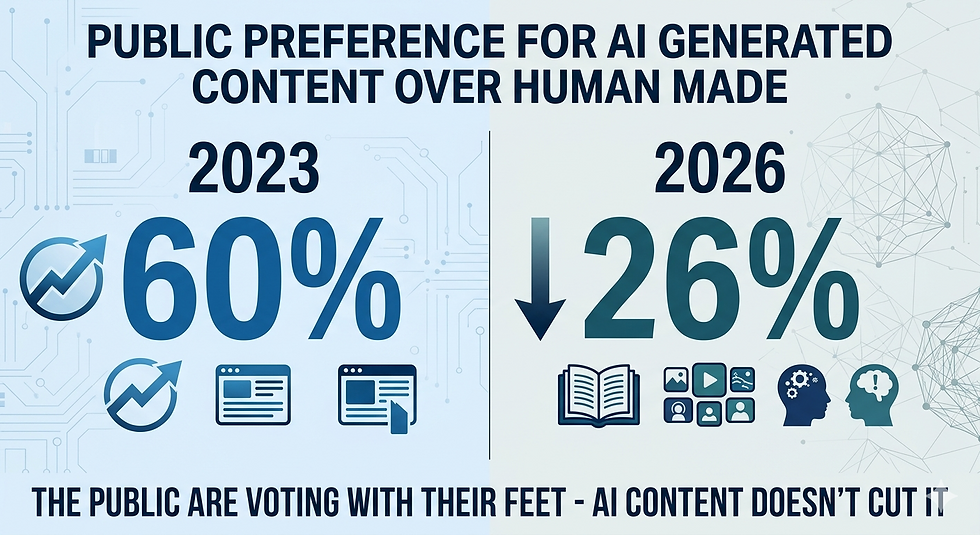
Unfortunately, audiences have twigged what’s going on – and they don’t like what they see. Research by content platform Bynder found that 52% of consumers disengage entirely when they suspect content is AI-generated. Preference for AI content has fallen from 60% in 2023 to just 26% today and mentions of “AI slop” increased ninefold during 2025. This is not a fringe reaction from a small group of content purists, it’s a measurable shift in how buyers relate to the material they encounter.
So, the problem isn’t that the content exists. It’s that so much of it says nothing, commits to nothing, and adds nothing.
What happens when nobody’s listening?
For a growing number of businesses, this question is becoming urgent. 29% of marketers say they've already cancelled or postponed campaigns because their audience is switching off. More than half of marketers say ad fatigue is a bigger challenge than ad blockers. In other words, the problem isn’t technical. It’s psychological.
Meanwhile, a growing share of digital content is only read by bots that jack up impressions and drive engagement metrics without delivering anything commercially meaningful. Businesses are investing in content that is talking to no one. The vanity metrics may look great, but it won’t move the pipeline.
This is today's medieval market. The sellers are screaming but the square is a ghost town.
The way out: post better, not more
Peak content is not the end of content marketing. It’s the end of content marketing done badly. Fortunately, there’s a clear route through this problem, and it’s to publish better.
Be worth stopping for. Before any piece of content goes out, ask yourself: would the person I’m trying to reach stop scrolling for this? Generic information assembled from other sources, dressed up with a few statistics and a call to action, won’t do. Readers have seen it before. They know exactly what it is.
Say something you actually believe. The easiest thing to spot in a wall of content is a piece that doesn’t commit to anything. Real insight means accepting risk, taking a position that’s backed by hard evidence or experience that only you have. That’s what earns attention. It also means being willing to say something your competitors won’t say.
Think carefully about where you publish. The businesses seeing the strongest engagement are not always the ones with the biggest platforms. They’re the ones building smaller, more intentional audiences: newsletters, curated channels, communities where relevance can be delivered consistently. Open platforms are getting noisier by the day. Direct relationships are becoming more valuable.
Make thought leadership earn the name. “Thought leadership” has become one of marketing’s most overused phrases. The real version is fairly straightforward: you have a point of view, it’s grounded in genuine expertise, and it tells your reader something they can’t find elsewhere. The fake version is full of puff, the humble brag, the insight that’s just a fudged up version of someone else’s ideas. This is a recipe for disaster. Readers know when you’re bullshitting and they won’t reward you for it.

If it ain't good, it's gone
The merchants who survived the cacophony in the market weren’t the ones who shouted loudest. They were the ones with something worth saying, said clearly, to the people who were actually listening.
Peak content means the bar has gone up. Audiences are more selective, more sceptical, and quicker to disengage than they have ever been. This is a serious problem for businesses pumping out volume without purpose. But for businesses willing to do the intellectual work, it’s an opportunity. When most of the noise is irrelevant, genuine signal stands out.
The question for any business right now is simple: are you just adding to the noise, or are you cutting through?
Final word
What's the last piece of content that actually made you stop scrolling, and what made it so different from the other stuff in your feed?
Follow Chris Godfrey for regular insights and opinion on the business of content & marketing. Subscribe to CONTENTED now


Get started with Freelance Words
Strong communication is the bedrock of good business and when there’s a lack of it, problems can arise. Take the ambiguity and doubt out of what your business needs to say. Contact us now.


Comments