So, you’re thinking of writing a book? This is what you're up against.

Updated: Jun 19
Getting a book published in the UK is genuinely difficult. Most submissions are ignored, agents are highly selective, and the Big Four publishers dominate the market — Penguin Random House alone accounts for nearly half of the top-selling titles. And if you think self-publishing is the fix, you're wrong, it simply trades one problem for many others. Lastly, there's the money - or lack of it. Even if you break through, the returns are bleak: the median UK author earns just £7,000 a year from writing. That's far less than minimum wage.
For some people, the dream of writing a book still carries a certain romance. You know what I mean; the quiet desk, the finished manuscript, the publisher’s advance, the review in a national newspaper, the satisfying sense that your work has “made it”.
However, for most aspiring authors, the reality is far less elegant.
The British publishing industry is difficult to enter, difficult to navigate, and difficult to earn from. It’s not impossible, but it is increasingly a game of patience, persistence, and hard commercial realism.
Knocking on a locked door
The first hurdle new authors face is access. Writers often imagine that if they produce a good manuscript it will be read by an experienced editor or commissioning person who will offer useful guidance.
Many submissions never get that far.
The Society of Authors has reported widespread frustration among writers querying the submission process, with 80% saying they usually received no information beyond an acknowledgment and 53% saying they did not even receive that. That doesn’t mean the industry never replies, but it does show how opaque and demoralising the process can be for newcomers.
Unfortunately, even when a manuscript is read, feedback is rarely generous.
Debut authors surveyed by The Bookseller described the publishing experience as disappointing, with many citing a lack of support and communication from publishers; 54% said publishing had a negative effect on their mental health, while only 22% described the experience positively. That’s a striking figure, and it tells us something important: the problem is not only rejection, but also the uncertainty and silence that can accompany it.
The distribution dilemma
A second big problem is the concentration of power.
UK publishing is increasingly dominated by a small number of large players, and that has consequences for who and what gets promoted. In 2024 the Big Four publishers’ market share rose to almost 50%, with Penguin Random House alone generating £389.4m in domestic print revenue from a total market of £1.822bn.
Additionally, 60 titles sold more than £1m each in the UK in 2024 and PRH published 26 of them. That’s almost half, and it’s a reminder that marketing budgets, sales focus, and retail attention naturally gravitate toward established names.
For a new writer, this means the odds are stacked against them before their book even appears. Publishers are businesses, and businesses like predictability. A well-known author with an audience in place is easier to sell, easier to position, and easier to justify to booksellers. A debut author may be talented, but talent does not guarantee sales. The reality is that publishers often need to spend heavily to launch a new voice, and in a cautious market they’re more likely to place their bets on safer options.
Agents? What agents?
The literary agent stage, which many writers consider as the gateway to publication, is an equally tough nut to crack
Agents do want new talent (in theory), but in practice they’re highly selective and receive far more submissions than they can possibly take on. There is no single industry-wide acceptance rate that fully captures the problem, but the evidence on response quality is revealing. A recent survey indicated that silence and minimal feedback are common features of the submission process. For a writer, this means you’re not simply trying to be “good enough”, you’re trying to stand out in a queue where the default outcome is ghosting.
Short stories get short shrift
Once, short fiction was a recognized way for writers to develop their craft, gain publication credits, and build credibility before moving on to long-form work.
That path is almost gone.
While short stories still matter artistically, they’re a weak commercial route into mainstream publishing, especially in book publishing where agents and publishers prioritise novel-length work. The sad fact is, the short story has now become more of a literary sideline than a stepping stone to greater things. A writer can be excellent at short fiction and still struggle to secure attention for a full-length book.
The awful financial returns
Then comes the money, or more accurately, the lack of it.
A 2022 survey of 60,000 UK authors found that primary occupation authors had median self-employed writing earnings of £7,000 per year, down from £11,329 in 2018. That's not a typo. The median full-time-ish writer is earning a level of income that sits well below the living wage, and the trend is going quickly in the wrong direction.
The Creative PEC policy brief adds further context: Only 19% of authors made all their money from writing in 2022, down from 40% in 2006. In other words, the proportion of writers able to rely solely on writing income has roughly halved over the last two decades.
Of course, this doesn’t mean that nobody makes serious money from books. Some do, and a very small number make a fortune. But the market is extremely uneven. A handful of established authors, often those already backed by strong commercial brands, account for the lions share of sales and attention.
This is why many writers describe the publishing industry as “long tail”: the top end does very well, but everyone below it is competing for scraps. For most debut writers, the economics are harsh. Advances, if offered, are often modest; royalties may take time to materialise; and a book that does not perform quickly can be quietly dropped from the shelves.
The false dawn of self-publishing
Self-publishing seems attractive at first glance. It promises control, speed, and freedom from the gatekeepers.
However, this route comes with its own challenges. In 2024, 46% of self-published authors earned $100 or less per month from writing, while only 17% were in the $2,500 to over $20,000 monthly range. Now, this is not UK-only data, so it should be considered carefully, but it illustrates the economic truth of the self-publishing world: most authors do not make anything like a meaningful income.
Self-publishing also requires the author to become a small business. The writer must fund editing, cover design, formatting, metadata, pricing strategy, advertising, and ongoing promotion.
Put plainly, self-publishing removes one barrier and replaces it with several others. You may not need to persuade a publisher, but you still need to reach and persuade readers, and that can be far more difficult than it sounds.
The ugly truth about talent
The deeper issue is that writing books is often discussed as if talent and perseverance are the main variables. They matter, of course, but on their own they’re not enough. The UK publishing system is shaped by market concentration, cautious buying decisions, limited feedback, and a commercial environment that strongly favours well-known names.
Even before you get to sales, most aspiring authors are trying to pass through a series of very tight gates. Once published, they may discover that visibility is limited and income is uncertain. If they go it alone, they face the hard realities of freelance entrepreneurship without any type of support system.
Final word
So, should you still write your book? Yes, if you have something to say and the discipline to see it through. But don’t imagine that publication will automatically bring recognition, editorial support, or financial stability.
The romantic version of authorship may still survive in the public imagination, but the data tells a colder story: the median author earns little, the market favours the already famous, and the road from manuscript to sustainable career is far narrower than many first-time writers expect.
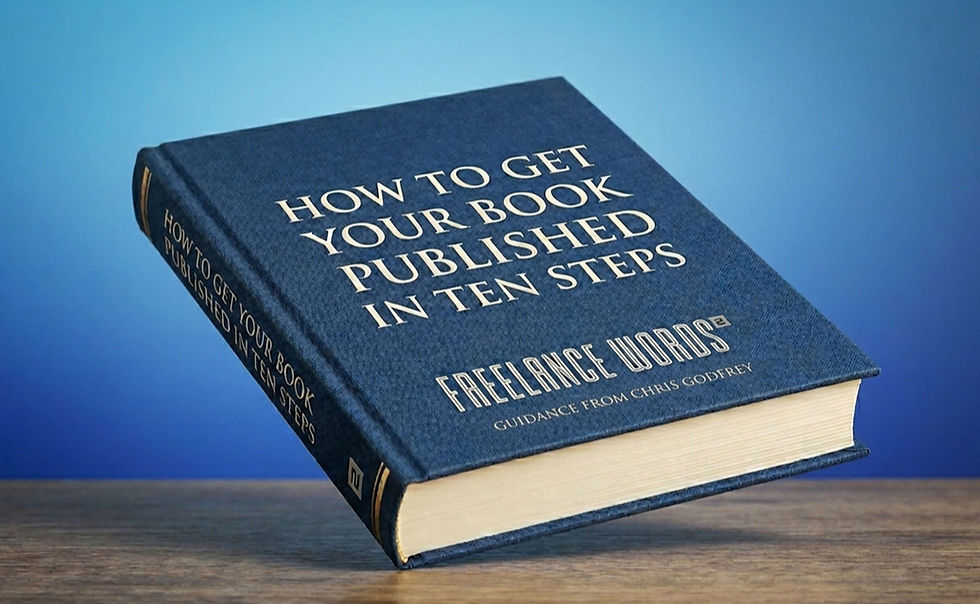
So, if this article hasn't put you off altogether and you're still determined to write that book, go ahead. See our ten point plan below to get you on your way.
Everything you need to know about getting published in one comprehensive GUIDE - click the image to view or download.
Follow Chris Godfrey for regular insights and opinion on the business of content & marketing. Subscribe to CONTENTED now


Get started with Freelance Words
Strong communication is the bedrock of good business and when there’s a lack of it, problems can arise. Take the ambiguity and doubt out of what your business needs to say. Contact us now.


Comments